

Transforming Higher Education for Community Transformation: A Decade of Mutual Capacity-Building in Northern Uganda
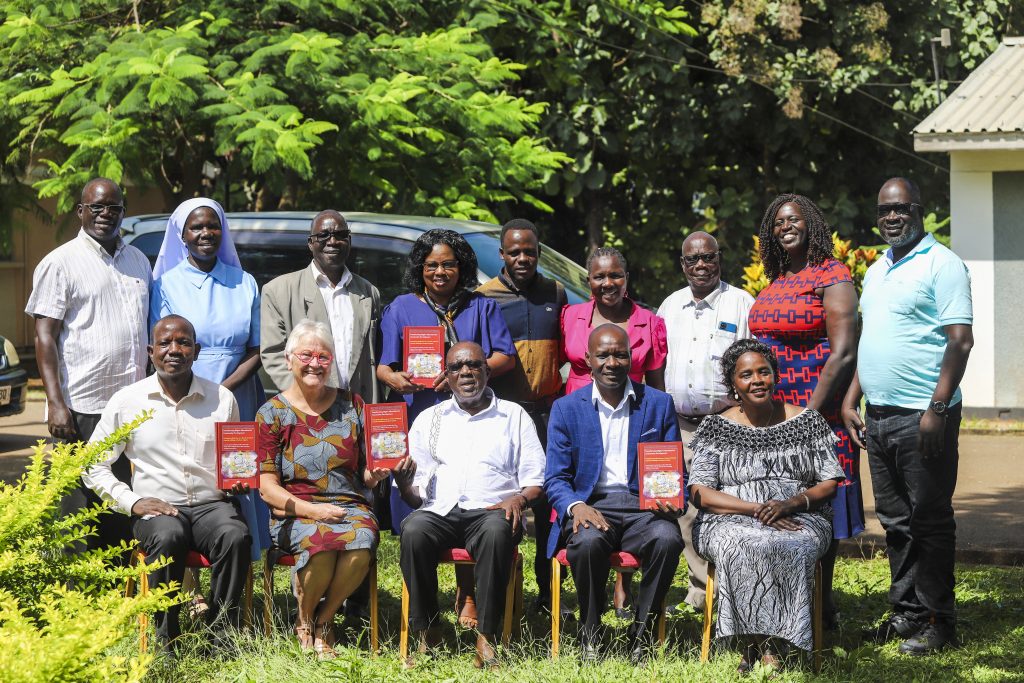
In November 2025, the Building Stronger Universities (BSU) programme launched at Gulu University a new book titled Transforming Higher Education for Community Transformation. The book was published in June 2025 by Brill. Lead editor Prof. Lone Dirckinck-Holmfeld of Aalborg University reflects on the book and its connection to the broader BSU journey:
This book represents ten years of shared history in the BSU family. Many of the articles are based on PhD research by authors who were supported through BSU II and III. We have been putting this book together since 2015, so it is a solid book based on a great deal of research.
For me, this book is also one of the clear examples of the impact of BSU. At the core of a university is the ability to do research and publish knowledge. It is therefore wonderful to see that BSU has supported so many PhDs whose work now appears in this volume.
When we started BSU in 2011, there were no PhD holders in the Faculties of Education and Humanities, nor in the Faculty of Business and Development Studies at Gulu University. Through the programme, BSU has contributed to the training of more than 20 PhD scholars.
It has also been a big learning experience to develop this book together. The volume is edited by Dr. Geoffrey Tabo, Associate Professor Charles Okumu, Professor Emerita Inger Lassen, and myself.
Transforming Higher Education
In the book we focus on transforming higher education and linking education to development. In the concluding chapters we are very clear: education is essential if we want development. But we also need to transform education itself — for students and for the wider community. In the book we show how this can be done through many practical cases.
Who the Book Is For
One of the target groups for the book is international development agencies that support programmes such as BSU.
In the first two chapters we discuss how collaboration works. Partnerships can function in many ways — North-South as well as South-South. We also bring examples from development research showing that collaboration does not always have to be North-driven.
In fact, BSU itself started as a North-driven programme but gradually evolved and became more South-driven.
The Soft Reform Space
I was inspired by a concept called the Soft Reform Space. I do not see BSU as a radical programme. The idea of the Soft Reform Space provides a useful framework for understanding how we work in BSU.
Change happens slowly. It takes time and patience. We need to develop a shared language, and we need transparency because we are working towards shared objectives that must be fulfilled. BSU has been built on a great deal of trust over many years. We started this journey in 2011.
Informing Policy and Practice
The book is also written for policy makers and practitioners — both those who make policies and those who implement them in East Africa, in Uganda, and particularly in northern Uganda. It includes discussions on competence-based curriculum development.
It is also relevant for top management at Gulu University and for the wider scholarly and academic community.
For example, if you are interested in school inspection, you can look at Dr. Jerry Bagaya’s chapter in Part 3: Secondary School Inspection Practices in Western Uganda: Implications for Pedagogy.
In the same section, Dr. Odama examines issues of educational leadership.
If you are interested in the decolonisation of academia, you can read the opening chapters written by the editors, as well as Part 2, which includes contributions by Dr. Agatha Alidri and Associate Professor Charles Okumu, where we discuss the role of the humanities.
Innovation in Teaching
If you are interested in curriculum innovation, you can turn to the final part of the book, which discusses innovations such as the use of IT in teaching. Dr. Geoffrey Tabo contributes an important chapter on this topic.
In the book we take a critical but also constructive approach to IT. We need to understand how technology can be integrated in ways that truly support the transformation of education and new pedagogical approaches.
Learning with Communities
Another important theme in the book is the need to establish educational formats where students, teachers, and communities all have a voice.
We believe in developing as we learn — developing ourselves while also developing our communities. Students can work together with communities to conduct research and development activities. The Problem-Based Learning (PBL) approach supports this and runs through many of the chapters in the book.
A Complete Package
It was also very rewarding to work together with artists who helped illustrate our work. Their contributions add another dimension to the book.
In this way, the book becomes a complete package — something readers can learn from, reflect on, and also enjoy.


